
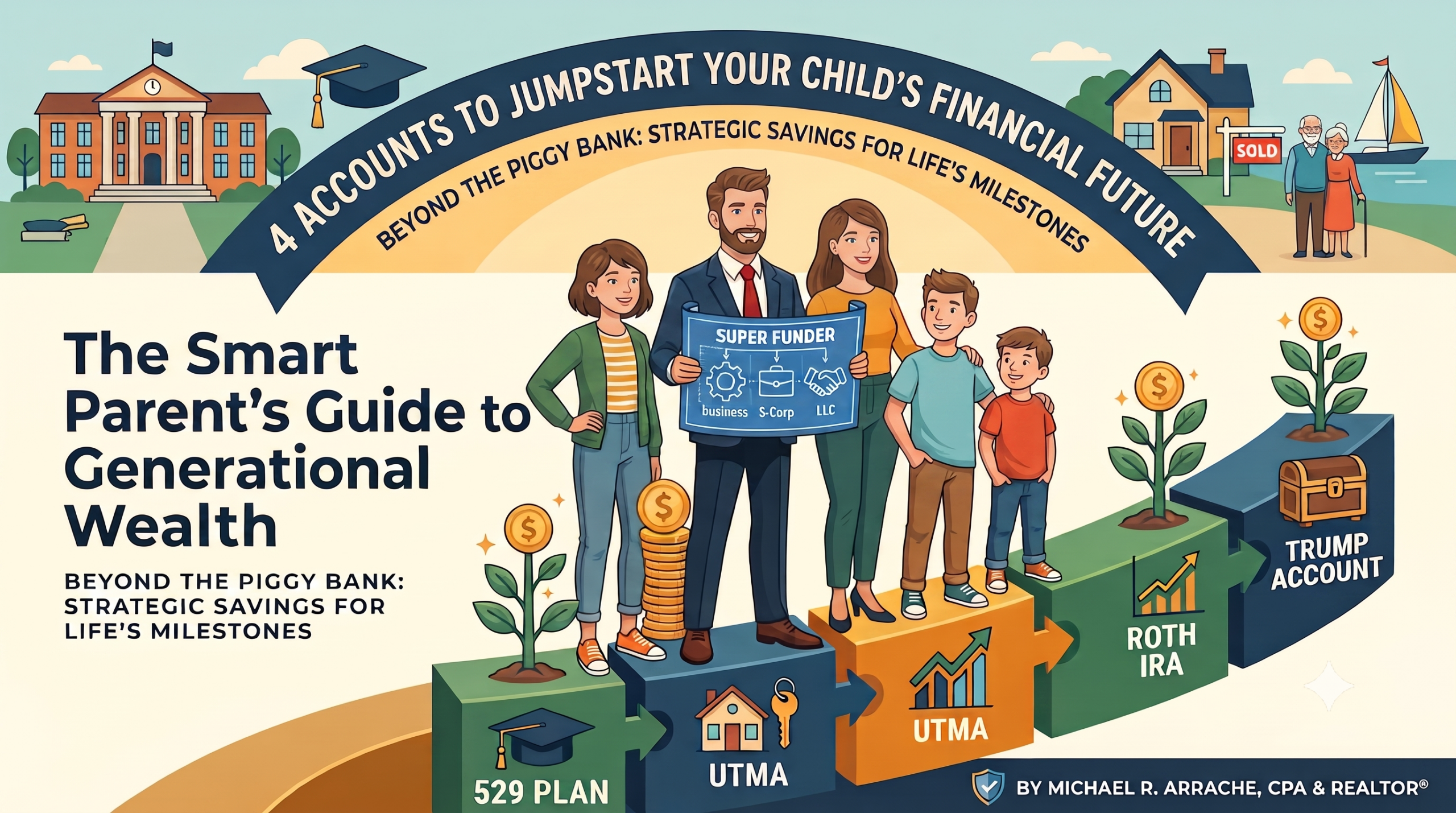
As parents, we all want to give our children a head start in life. Whether it’s helping them buy their first home, funding their education, or ensuring they never have to worry about retiring broke, the choices we make today set the trajectory for their tomorrow.
But before you open a random savings account or pick an index fund, you need to answer two foundational questions:
- What exactly am I saving for? (College? A home down payment? Lifelong retirement security?)
- How much do I realistically want to commit per year?
Different financial goals require completely different savings tools. Here is how to map out your child’s milestones and select the right accounts to build true generational wealth.
Why Are You Saving? (Mapping the Milestones)
To build an effective savings strategy, you first need to identify the target milestones. Most parents focus on four major life events:
- Education: Funding college, trade school, or private K-12 tuition so they can enter adulthood free of student loan debt.
- The First Home: Providing a financial launchpad to help them secure a real estate down payment in an increasingly expensive housing market.
- Health & Special Needs: Establishing a dedicated medical safety net for unforeseen emergencies or lifelong specialized care.
- Retirement: Unlocking the mathematical magic of 50 to 60 years of compound interest. By planting a small seed today, you can guarantee they become millionaires by the time they retire.
The 4 Primary Account Types (Your Toolkit)
Once you know your goals, you can choose the right account. Here is a quick, scannable breakdown of the four primary vehicles available to parents today:
1. 529 College Savings Plans
- Best for: Tax-free growth and tax-free withdrawals when used strictly for qualified education expenses.
- The Catch: If your child decides not to go to college, non-educational withdrawals face tax penalties (though modern tax rules do allow you to roll over unused portions into a Roth IRA under specific limits).
2. UTMA / UGMA Custodial Accounts
- Best for: Pure flexibility. The money grows in a custodial investment account and can eventually be used for anything—a first home down payment, buying a car, or funding a business startup.
- The Catch: Legally, the money belongs entirely to the child once they hit adulthood (age 18 or 21 depending on the state). As the parent, you lose control over how they choose to spend it.
3. Custodial Roth IRAs
- Best for: Building a massive, 100% tax-free retirement nest egg early in life.
- The Catch: The IRS has a strict gatekeeping rule: the child must have legitimate earned income (like a part-time job, modeling, or business tasks) to contribute. You cannot fund a Roth IRA using cash gifts or allowance.
4. Trump Accounts
- Best for: Snagging the government’s $1,000 kickstart seed (for eligible children born between 2025 and 2028) or securing the newly launched $250 Dell Foundation charitable deposit (available for up to 25 million eligible kids age 10 or younger born before 2025 who live in ZIP codes with a median income under $150,000). Once funded, the account provides automatic S&P 500 compounding for long-term retirement wealth.
- The Catch: These are designed as strict, government-sponsored traditional IRAs with set annual contribution caps, making them excellent long-term anchors but less ideal for near-term flexibility.
- Check Your Eligibility: Parents can check if their children qualify for the initial federal seed deposits and open an account directly via the official government portal at TrumpAccounts.gov or by reviewing guidelines on the IRS Trump Accounts Page. To check your family’s eligibility specifically for the private $250 Dell Foundation milestone gift, you can use the interactive checking tool hosted at InvestAmerica.org.
🚀 Business Owners: Want to Supercharge Your Child’s Savings Tax-Free?
If you own a profitable business or S-Corporation, standard personal savings accounts are just the tip of the iceberg.
There are advanced, highly sophisticated tax strategies that allow business owners to legally hire their children, pay them a reasonable wage, write off the entire expense as a business deduction, and completely bypass payroll taxes. This creates a bulletproof loop where you fund your children’s Roth IRAs, Trump Accounts, 529s, and UTMAs using pre-tax business revenue—effectively wiping out your own high personal tax bill in the process.
Want to learn how to deploy our signature “Super Funder” strategy for your family?

About the Author
Michael R. Arrache, CPA & Realtor®
As a dual-licensed Certified Public Accountant (CPA) and Realtor® with over 15 years of sophisticated financial experience, Michael analyzes every wealth-building strategy through a rigorous dual-lens. His practice is dedicated to helping business owners, high-net-worth families, and real estate investors design legacy-driven tax frameworks. By specializing in advanced corporate structures and family management loops, Michael helps clients seamlessly shift active income into generational wealth—surgically defending their hard-earned equity against unnecessary tax burdens.