
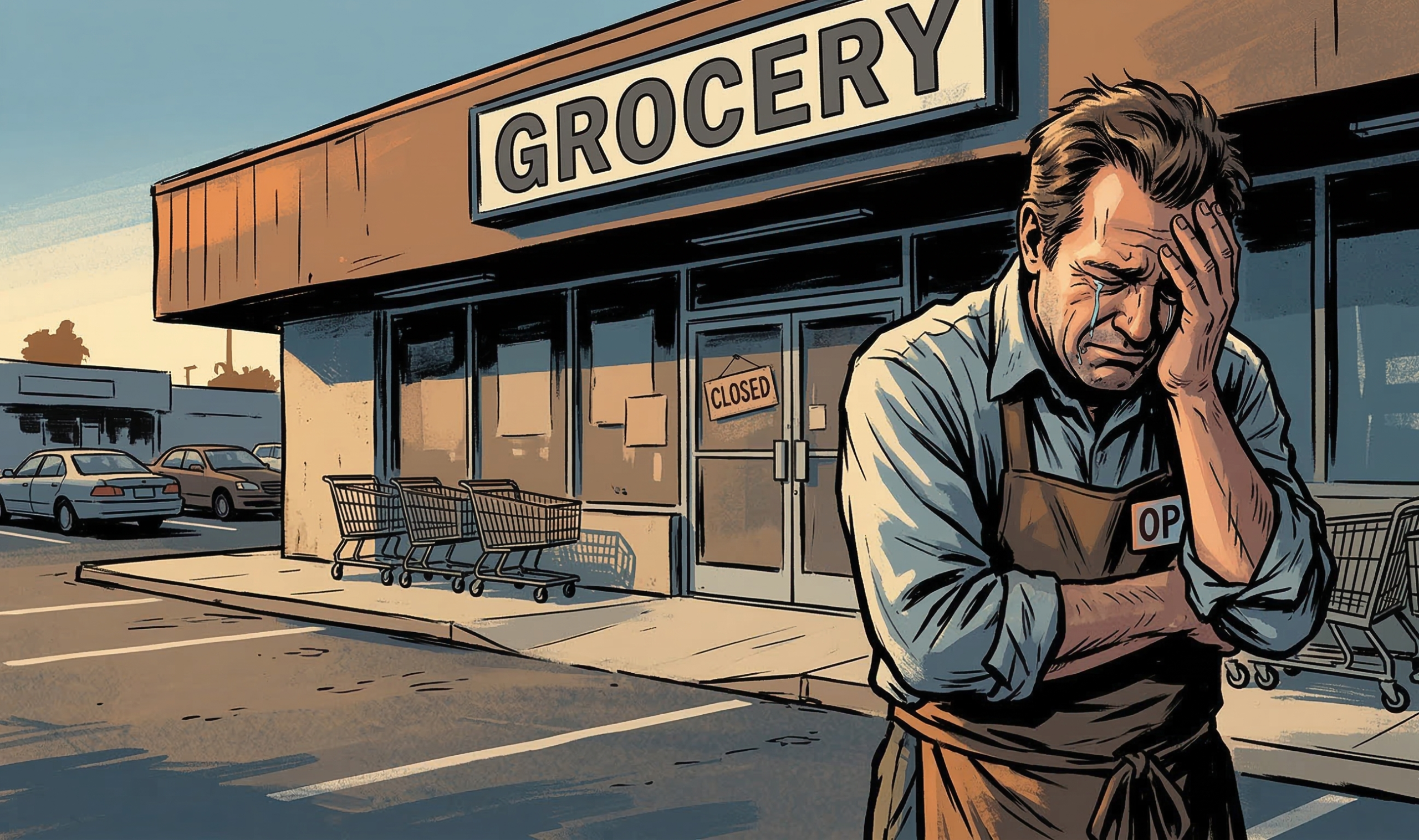
Retail is a game of margins, but when the math is rigged against the operator, even a $20,000-a-day revenue stream can become a financial death trap.
A recent closure of a high-volume grocery franchise location serves as a masterclass in the “Concentration of Risk” many business owners face. When a franchisor controls the supply chain, the accounting software, and the financing, the “Independent Operator” is often just a leveraged participant in someone else’s ecosystem.
Here is the “So What”: if you are a high-net-worth business owner in a similar bind, your exit isn’t just about “throwing in the towel.” It is a complex tax maneuver that requires a deep understanding of Basis, Insolvency, and Section 1244.
The Anatomy of a Failing Model: High Revenue, Zero Margin
The location in question was moving significant volume—roughly $20,000 in daily sales ($7.3M annually). But the underlying math was brutal:
- The 1% Razor: The gross margin hovered at a mere 1%.
- The Split: That thin margin was split between the operator and the franchisor.
- The Weight: From a 0.5% share, the operator had to cover payroll, rent, utilities, and royalties.
The “Tech” Failure: Around year three, the franchisor transitioned to a new SAP-based accounting platform. This transition—now the subject of multiple shareholder lawsuits—caused massive inventory and ordering disruptions. When invoices become unreliable and delayed, an operator loses their primary lever: Data. When staff time is spent manually reconciling broken invoices rather than driving sales, the business is in terminal decline.
The Debt Trap: The Line of Credit (LOC)
When a business operates in a losing position, franchisors often provide a Line of Credit (LOC) to keep the doors open. It feels like a lifeline, but it is often a mounting liability. Upon closure on 12.31.25, the operator was left with a massive LOC balance and a broken corporate entity.
The Tactical Exit: Navigating the Tax Fallout
Closing the doors is only Step 1. Step 2 is managing the tax wreckage.
1. The Inventory Buy-Back: Refund vs. Income
Upon closing, the franchisor bought back the remaining goods. Since the operator is an accrual-basis taxpayer, the timing here is critical.
- The Treatment: This isn’t “new” income; it’s a reduction of Cost of Goods Sold (COGS).
- The “CFO” Angle: We must verify if the franchisor issued a 1099 or simply netted the buy-back against the LOC. If they netted it, it reduces the debt, which directly changes the Cancellation of Debt (COD) calculation.
2. COD Income & The Insolvency Exclusion ($IRC \S 108$)
If the franchisor “charges off” the remaining LOC, the IRS views that as taxable ordinary income to the S-Corp.
- The Win: For S-Corps, the Insolvency Test is performed at the Corporate level. If the S-Corp’s liabilities exceed the fair market value of its assets (which are near zero at closure), the COD income is excluded from tax.
- The Strategy: This allows us to “wash” the debt without it flowing through as a massive tax bill on the owner’s personal return.
3. Section 1244: The $100,000 “Silver Lining”
Usually, a loss on an investment is a Capital Loss, capped at $3,000 per year. That is a 30-year recovery period for a major hit.
- The Knowledge Bomb: Under $IRC \S 1244$, if the business was a “small business corporation” at inception, an individual can treat up to $100,000 (for married filing jointly) of the loss on their stock as an Ordinary Loss.
- The Impact: This can offset high-bracket income (like Real Estate commissions or a spouse’s W-2) immediately in the year of liquidation.
The “S-Corp Shield” & Basis Limitations
Many owners fear closing their S-Corp will “pierce the veil.” While the corporate shield is vital, keeping a “zombie” corp open is a drain. More importantly, we must reconstruct the owner’s Basis. If the $20k/day revenue was offset by franchisor debt that the owner wasn’t personally liable for, they may have At-Risk limitations ($IRC \S 465$) that “trap” their losses at the corporate level.
To use these losses, we must ensure the owner has enough “skin in the game” (Basis) to pull those deductions onto their personal return.
The Bottom Line
In high-revenue, low-margin businesses, the “Profit” isn’t just what you make on the sale—it’s what you keep after the taxman and the franchisor are done. If you are sitting on a balance sheet full of mounting debt and unreliable data, you need a strategy that looks at the Convergence of your legal entity and your tax liability.
Is your business model operating on a “Razor’s Edge”?
Don’t wait for the “Charge Off” notice to start planning your exit.

About the Author
Michael R. Arrache, CPA & Realtor®
Michael Arrache is the Lead Content Strategist and founder of Arrache Private Client, specializing in Tax Alpha, CRE Intelligence, and Fractional CFO services. APC helps high-net-worth individuals and business owners transform technical wreckage into strategic exits.